
How to solve the Z-index issue Within 1 minute

Welcome Developer to my blog post, This post is more beneficial to the frontend developers as this tool work with the frontend stuff, but yes it always helps to have the knowledge about what tools are your front-end developers friend using.
so my dear frontend developer friend, I know that you make the Designs of the awesome website with the help of the HTML and CSS and make them interactive with the help of javascript. but things don't always work as we want.
Alt Text
I am going to share one tool inside the chrome dev tool that you can you while debugging the next issue for the Z-index.
Z-Index:
Alt Text
Z-Index is an important property of CSS. The z-index property specifies the stack order of an element and its descendants. We use Z-index with absolute or relative positions. When elements overlap, z-order determines which one covers the other.
You must have used this one property while making any design and sometimes the Div which you want to show on the top not display whether you give it the Z-Index of 1000000.
Alt Text
Don't keep hit any try with giving the random number. use the following tool to check where your div element is positioned. you must be frustrated while doing this

Alt Text
keep calm and
1) open Chrome Dev tools
2) Click on three dots on the right-hand side and open more tools and select layer
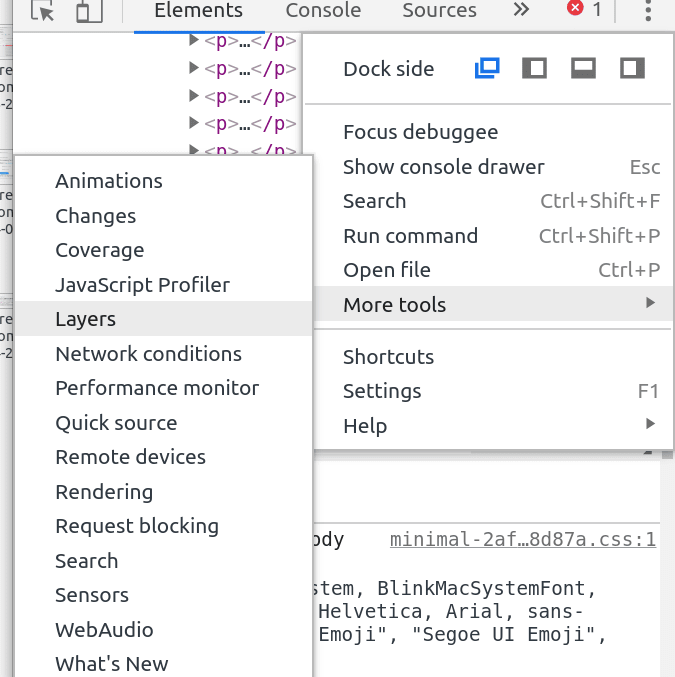
Alt Text
now you get the following screen
Alt Text
--> There are three options available under the console text, the First mode is pan mode this used to drag the given window inside the layer window, the second mode is Rotate mode, you can use this mode to rotate the window and to see how the elements are positioned, and the third one is used to reset the 1st and 2nd settings.
open the devtool if you are reading this post from your laptop or pc and give it a try. you can see how the elements are positioned on any website. there are more two options play with them also

Comments

Popular posts from this blog

4 Ways to Communicate Across Browser Tabs in Realtime

1. Local Storage Events You might have already used LocalStorage, which is accessible across Tabs within the same application origin. But do you know that it also supports events? You can use this feature to communicate across Browser Tabs, where other Tabs will receive the event once the storage is updated. For example, let’s say in one Tab, we execute the following JavaScript code. window.localStorage.setItem("loggedIn", "true"); The other Tabs which listen to the event will receive it, as shown below. window.addEventListener('storage', (event) => { if (event.storageArea != localStorage) return; if (event.key === 'loggedIn') { // Do something with event.newValue } }); 2. Broadcast Channel API The Broadcast Channel API allows communication between Tabs, Windows, Frames, Iframes, and  Web Workers . One Tab can create and post to a channel as follows. const channel = new BroadcastChannel('app-data'); channel.postMessage(data); And oth...

Certbot SSL configuration in ubuntu

  Introduction Let’s Encrypt is a Certificate Authority (CA) that provides an easy way to obtain and install free  TLS/SSL certificates , thereby enabling encrypted HTTPS on web servers. It simplifies the process by providing a software client, Certbot, that attempts to automate most (if not all) of the required steps. Currently, the entire process of obtaining and installing a certificate is fully automated on both Apache and Nginx. In this tutorial, you will use Certbot to obtain a free SSL certificate for Apache on Ubuntu 18.04 and set up your certificate to renew automatically. This tutorial will use a separate Apache virtual host file instead of the default configuration file.  We recommend  creating new Apache virtual host files for each domain because it helps to avoid common mistakes and maintains the default files as a fallback configuration. Prerequisites To follow this tutorial, you will need: One Ubuntu 18.04 server set up by following this  initial ...

Working with Node.js streams

  Introduction Streams are one of the major features that most Node.js applications rely on, especially when handling HTTP requests, reading/writing files, and making socket communications. Streams are very predictable since we can always expect data, error, and end events when using streams. This article will teach Node developers how to use streams to efficiently handle large amounts of data. This is a typical real-world challenge faced by Node developers when they have to deal with a large data source, and it may not be feasible to process this data all at once. This article will cover the following topics: Types of streams When to adopt Node.js streams Batching Composing streams in Node.js Transforming data with transform streams Piping streams Error handling Node.js streams Types of streams The following are four main types of streams in Node.js: Readable streams: The readable stream is responsible for reading data from a source file Writable streams: The writable stream is re...